

Promptable endpointing: tell the agent when to keep listening
Knowing when a caller has finished speaking is the hardest part of a phone call. We built a model for it, and then gave you a plain-language way to tell the agent when to wait, like while someone reads out an account number.
Every voice agent has to make the same decision hundreds of times per call: has the caller finished, or are they only pausing? Get it wrong one way and the agent answers over people. Get it wrong the other way and every reply comes after an awkward silence. Callers notice both, and they describe both the same way: it feels like talking to a machine.
For years the industry answered that question with a stopwatch. Wait for a fixed stretch of silence, then reply. That is fine for a quick yes or no. It falls apart the moment someone reads out a phone number, an account number or a booking reference, because people pause between the groups of digits, and those pauses are longer than the stopwatch allows. The agent jumps in halfway, the caller starts again, and the call that should have taken a minute takes three.
Why we built our own
We saw this on real calls, in Arabic and in English. Callers dictating a number pause for several seconds between groups. Settings tuned to be patient enough for that made every other reply slow, and settings tuned for speed cut people off. There was no number on the dial that was right for both.
So we replaced the stopwatch with judgement. First, a model of our own that listens to the sound of the caller's voice and tells a pause to think apart from the end of a sentence, trained for English and for Arabic in all its dialects, on the narrow sound of a phone line. It decides in about forty milliseconds, so it costs nothing you can hear.
Then we made it promptable
Sound alone cannot know that the caller is in the middle of an account number. The agent can, because it asked for it. Promptable endpointing lets you tell the agent, in plain words, when it should keep listening: while the caller reads out a number, while they spell a name, while they think out loud. The agent holds the turn quietly, the caller never hears a thing, and the answer comes once they are done.
It is one field on the agent's Behavior tab. Leave it blank and the platform's default applies. Write a sentence and that agent follows it from the next call. A maximum wait sits underneath as a safety net, so a held turn can never become dead air.

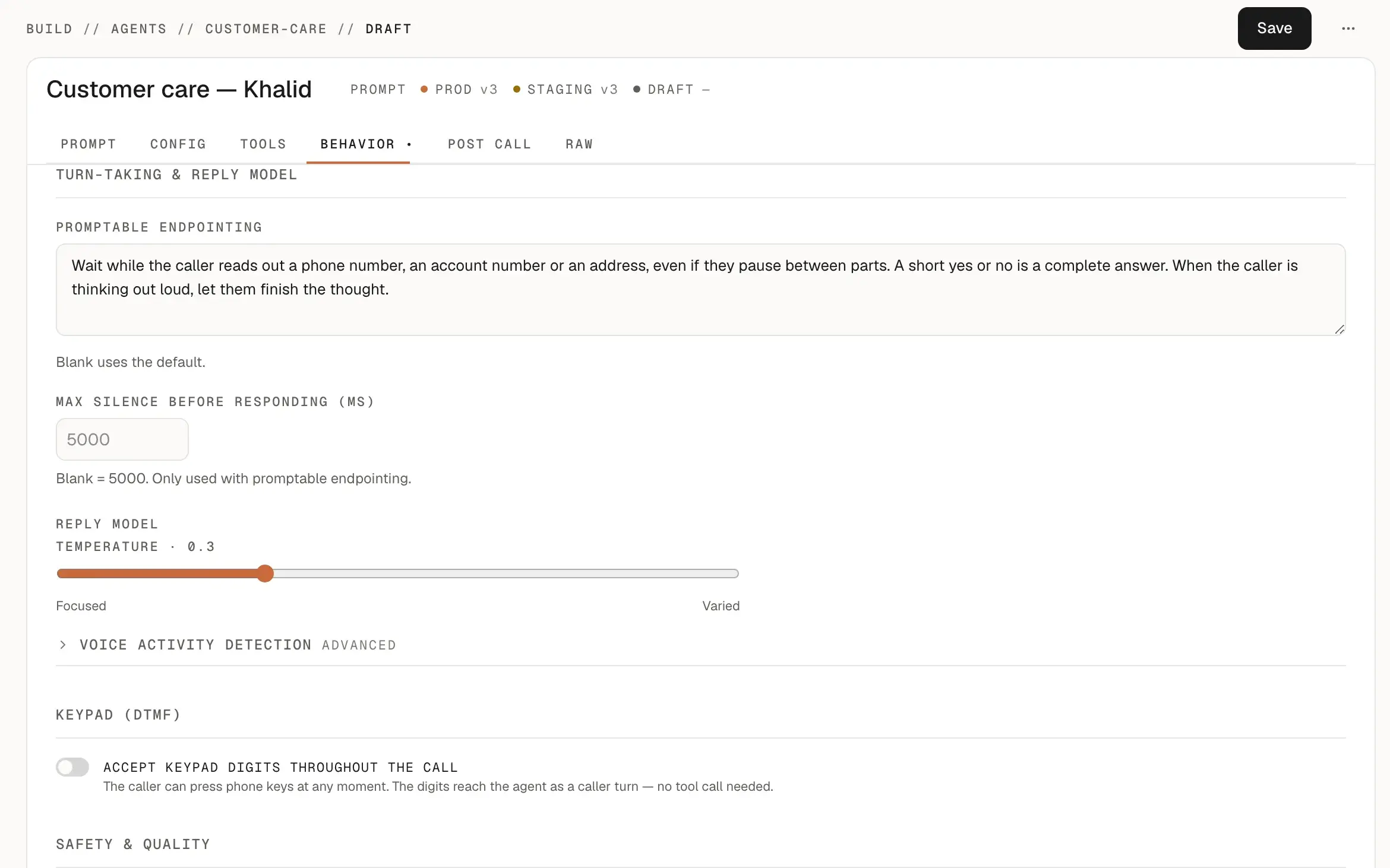
The Behavior tab. One sentence tells the agent when to keep listening; the maximum silence setting makes sure it never waits forever.
What it changes on the call
A caller can read a sixteen-digit card reference with a breath between every four digits and be heard in full. A short answer still gets a quick reply, because nothing about a quick answer tells the agent to wait. And the balance between patience and speed stops being a single number an operator has to guess, and becomes something you describe.
The result shows up on every call's Latency tab, where turn detection is measured per turn, so you can see what a change to the instruction did rather than take it on faith.
What else
shipped.
 Product · 2 November 2026
Text-to-speech V2: 24 English accents and 20 Arabic dialects
The second generation of our own text-to-speech is live on every workspace. More accents, more dialects, and a voice catalog of 433 voices that an agent can be switched to in one click.
 Product · 20 October 2026
Speech-to-text V2: faster, more accurate, and better with everyday speech
The second generation of our own speech recognition is live. It is faster, it is more accurate, and it understands colloquial speech and slang across the dialects it was trained on.