

Groups: A/B test agents on live calls
Put two or more agents in a group, point a phone number or a campaign at it, and compare them on real traffic. Weighted, sticky per caller, measured on every call, and honest about when the numbers are not in yet.
Every team that runs a voice agent ends up with the same argument. Should the greeting be formal or warm? Does the shorter prompt convert better? Is the new voice actually an improvement, or does it just sound better in the office? Until now the answer was a test call, an opinion, and a change pushed to everyone.
Groups replace the opinion with a split. A group is two or more existing agents with a traffic weight each. Point a phone number, an outbound call or a whole campaign at the group instead of at one agent, and every call goes to one member in proportion to its weight. The agents themselves are not touched.

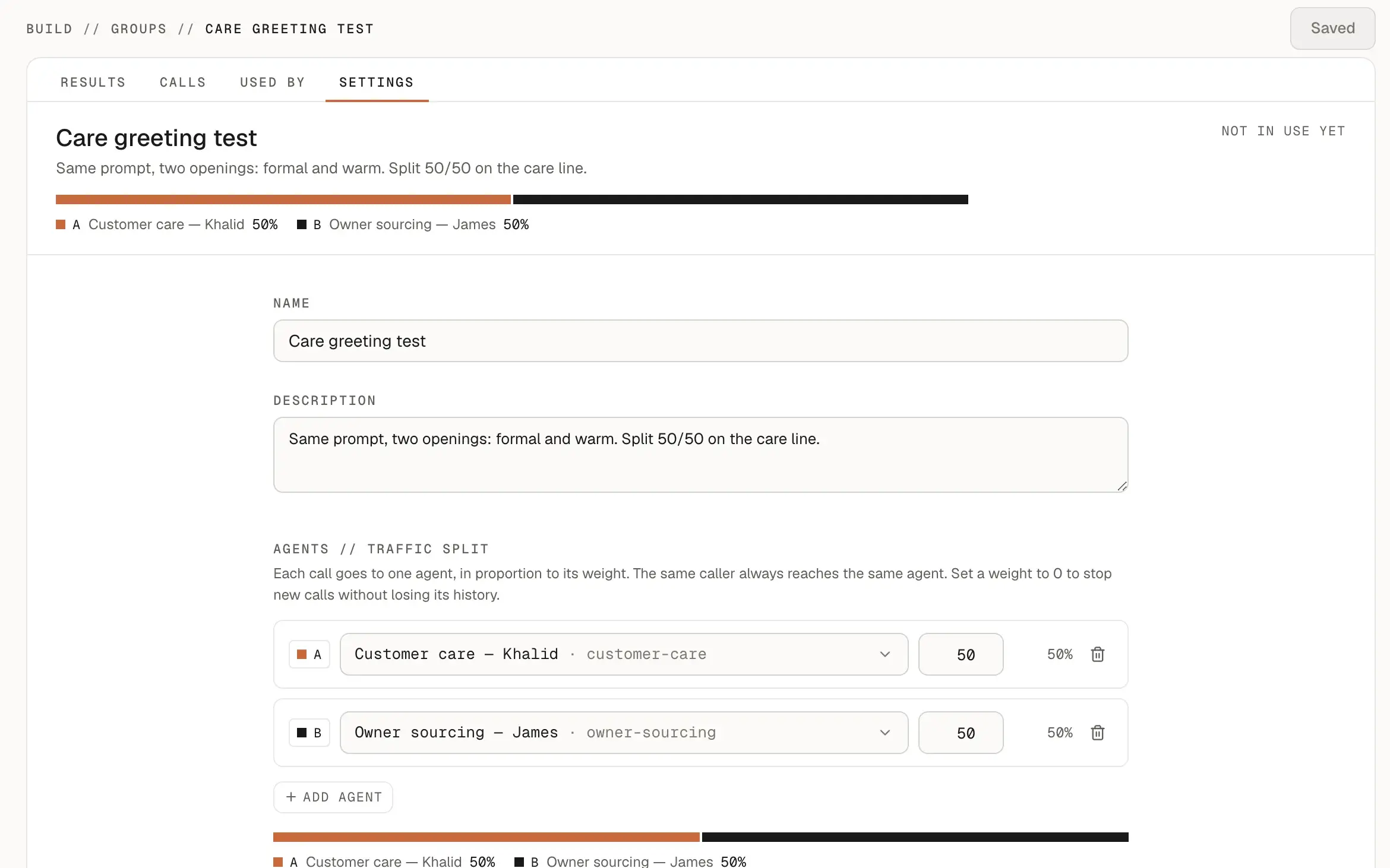
A group with two agents at 50/50. Set a weight to 0 to stop new calls to a member without losing its history.
Sticky, weighted, changeable
The same caller always reaches the same agent while the group is unchanged, so a customer who calls back on Tuesday does not meet a different personality than on Monday. Weights are relative, 0 to 100, and can be changed while the group is live. Raising one agent's share moves only the callers it gains; nobody else is reshuffled. A weight of 0 keeps the agent and its history but sends it nothing new.
Up to ten agents can sit in one group. Changes to members and weights are recorded, so the results charts mark the day B went from 50% to 80%.
Measured on every call
The Results tab compares the members on what the platform already knows about every call: calls taken, answer rate for outbound, average length, transfer rate, failures, early hang-ups, tool failures and response latency. On top of that, after each call a small model scores the agent's overall performance from 1 to 10 and records whether the goal was achieved, partially achieved, not achieved or escalated.
You can add up to twenty metrics of your own, in plain language, and they are extracted from every transcript in the group alongside whatever each agent already extracts for itself.

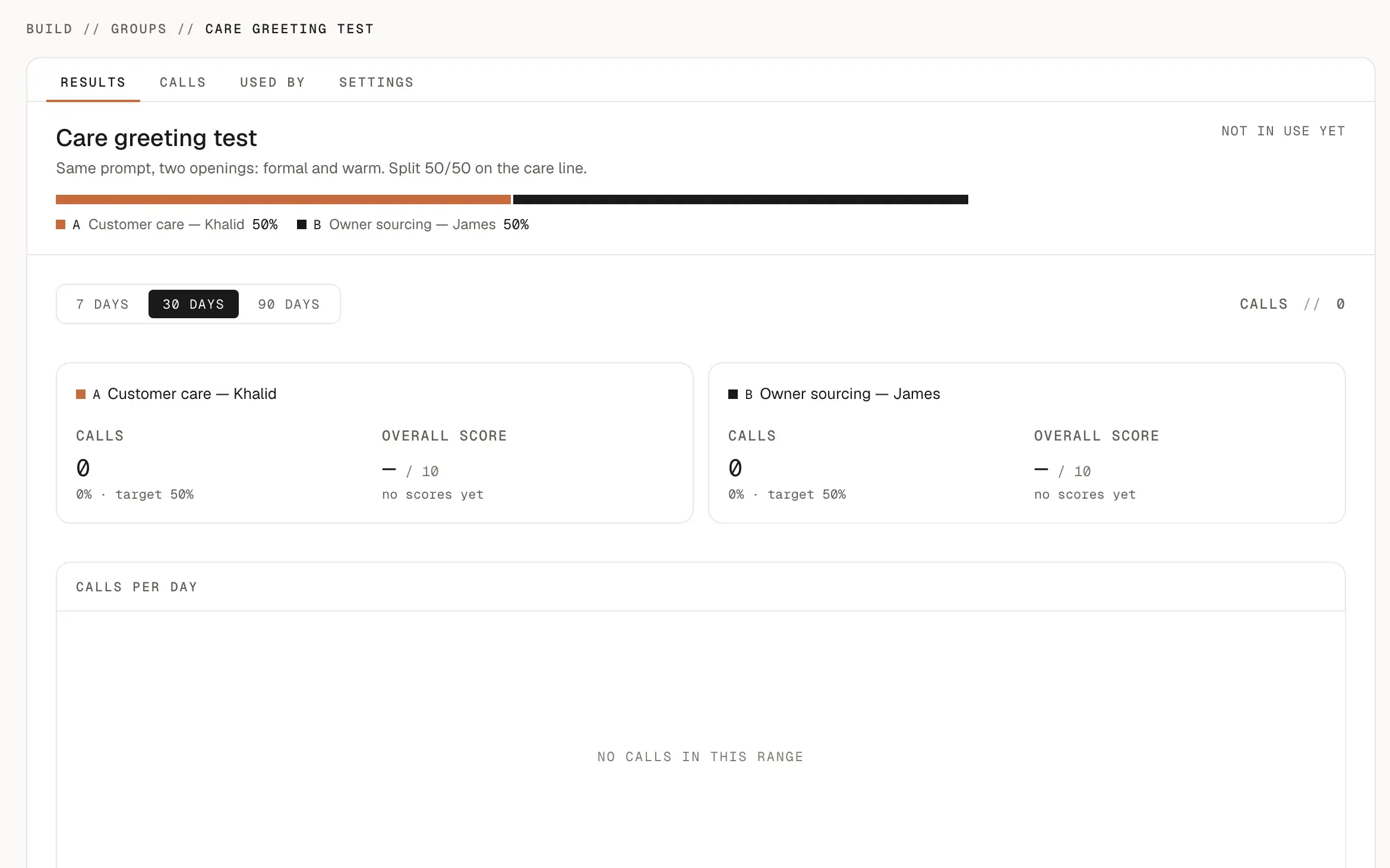
Results. Each metric carries a verdict, and the verdict waits for thirty calls per agent before it names a leader.
Honest about small numbers
Forty calls do not prove anything, and the product says so. Every rate carries a confidence interval, and a metric only names a leader once each agent has at least thirty calls and the difference clears a 95% test. Until then the verdict reads "not enough calls yet". Call length is reported but never used to declare a winner.
There is no crown-the-winner button, on purpose. When you are convinced, set the better agent to 100%, or point the number at it directly. The group keeps its history either way.
- Works on inbound numbers, outbound calls and campaigns
- Members run their current production version
- Groups is switched on per workspace. Ask us and it appears under Build.
What else
shipped.
 Product · 2 November 2026
Text-to-speech V2: 24 English accents and 20 Arabic dialects
The second generation of our own text-to-speech is live on every workspace. More accents, more dialects, and a voice catalog of 433 voices that an agent can be switched to in one click.
 Product · 20 October 2026
Speech-to-text V2: faster, more accurate, and better with everyday speech
The second generation of our own speech recognition is live. It is faster, it is more accurate, and it understands colloquial speech and slang across the dialects it was trained on.