

The world's first Arabic-native speech language model
A model that hears the caller and answers, with no transcript in between. Trained on Arabic as it is spoken across the region and on English, it listens to tone and hesitation the way a person does, and it runs on your own hardware.
Until now, a voice agent on the phone worked like a relay. One model turned the caller's speech into text, a second model read the text and wrote a reply, a third turned the reply into speech. Every handoff cost time, and the middle model never heard the caller at all. It did not know whether the person was certain or hesitant, calm or losing patience, finishing a sentence or searching for a word.
Today we are releasing a speech language model that removes the relay. It hears the caller's audio directly and produces the reply. There is no transcript between the ear and the answer, so nothing is lost on the way, and the reply starts sooner because there is one step where there used to be two. It is one step closer to a true real-time model: one that listens and speaks the way a person does, with nothing in between.
Built for Arabic first
Most speech models learn Arabic as an afterthought, through text, and through the standard form that almost nobody speaks on the phone. Ours was trained on Arabic as it is actually spoken, across the Gulf, the Levant, Egypt, Iraq and the Maghreb, and on English alongside it. It does not need to be told which dialect it is hearing. It recognises the dialect from the voice and answers in kind.
When a caller switches language mid-call, the model switches with them, turn by turn. The agent's voice stays the same throughout, so the customer hears one person who happens to understand both.
It does the work, not only the talking
While it listens, the model can look up the caller in your CRM, check an offer, book a slot, or hand the call to a person with a briefing, all mid-conversation. A call does not pause to think; the reply and the lookup run together.
In the dashboard it is one choice on the agent's Config tab. Pick the Ultra pipeline and the speech model hears the caller directly. Everything else about the agent, its prompt, tools, guardrails and voice, stays the same.

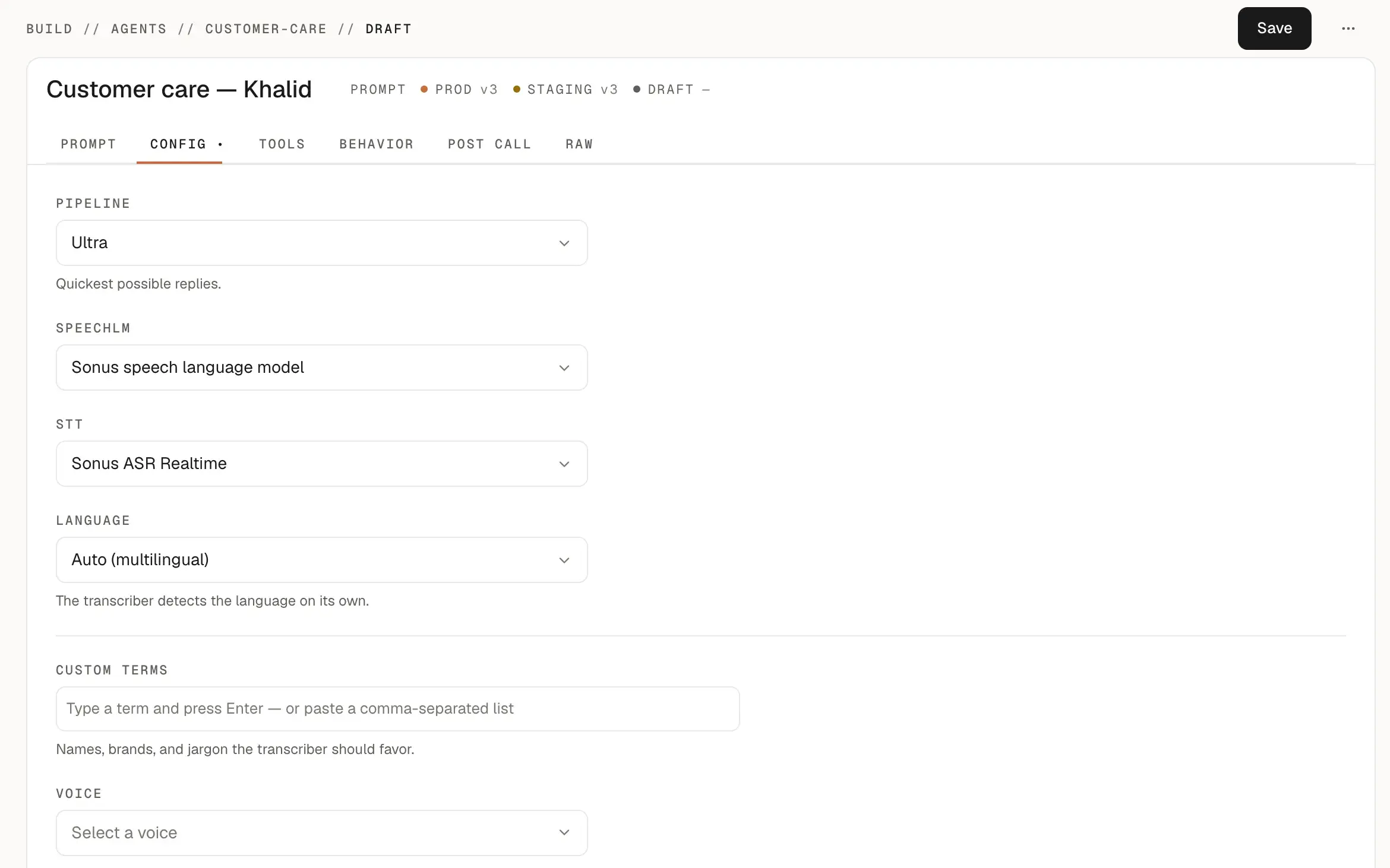
The Config tab. Ultra puts the speech language model directly on the caller's audio; a transcriber runs alongside for the record.
Inside your perimeter
The model runs on GPUs inside the deployment, on our cloud, in your cloud account, or on your own servers with no connection to the outside world. Audio never leaves. For banks, telecoms and government, that is not a feature; it is the condition for using voice AI at all.
What else
shipped.
 Product · 2 November 2026
Text-to-speech V2: 24 English accents and 20 Arabic dialects
The second generation of our own text-to-speech is live on every workspace. More accents, more dialects, and a voice catalog of 433 voices that an agent can be switched to in one click.
 Product · 20 October 2026
Speech-to-text V2: faster, more accurate, and better with everyday speech
The second generation of our own speech recognition is live. It is faster, it is more accurate, and it understands colloquial speech and slang across the dialects it was trained on.